Community
Costa Rica is a country that is well known for its natural resources, being water one of the more abundant and appreciated ones. However, in the past few years, the poor urban development and the effects of climate change, has made this resource scarce in the city of San Jose, specially during the dry season, where “Acueductos y Alcantarillados” or AyA (Spanish for Aqueducts and Sewers) have been applying water cuts all over the city.
Unfortunately, these water cuts don’t affect everyone equally, but mostly the more highly dense populated neighborhoods, who, at the same time, happen to be the poorest ones.
During the cuts, AyA is normally asking all the water users to reduce their water consumption to the minimum, in a way that there’s water for all the people in San Jose, but unfortunately, most of the people don’t take any action due to the fact that they haven’t experienced the cuts because they live in more privilege neighborhoods, and it’s usual to see people watering their gardens, washing their cars, filling their pools, while just a few kilometers away, some people are dealing with the fact of not having running water during most of their days.
For this class, the goal was to explore a way to apply some behavioral change techniques that challenge some of the cognitive biases identified in this problem in San Jose. Those biases are:
- Social proof: Individuals look at how others behave, and seeing that most of the people don’t take actions, they won’t see how their actions might affect the problem.
- Intention-Action gap: The disconnect between what a person wants to do and what they actually do.
- Status quo bias: People tend not to change an established behavior unless the incentive to do is compelling enough.
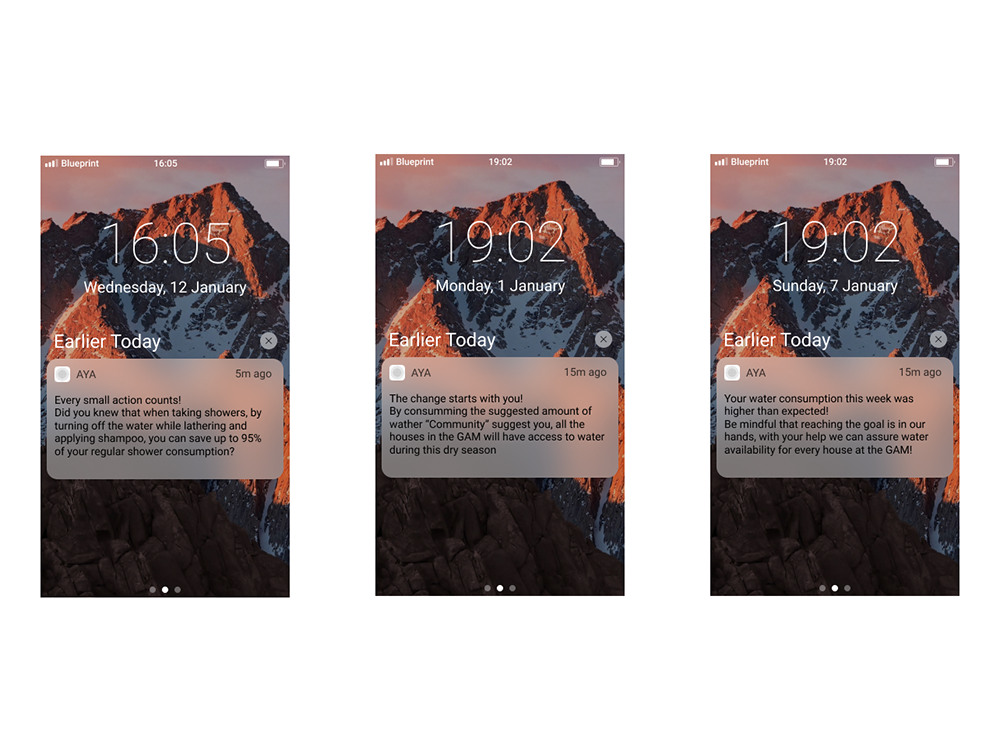
Community is an one day project, that consist in a device that by being connected to the already existing water meter in the house, will every month set what’s the water consumption limit, suggested for every home (knowing the amount of persons living in the house) and tracking and comparing the actual consumption with the suggested one, by week. The other part of the service is a set of text messages that will be sent at the beginning of every month remembering some specific actions the users can take to rescue their water consumption, as well as alerts when they’re exceeding the expected consumption every week. Those text messages are being sent through SMS technology, avoiding having to download any app and therefore, making it more accessible and easy to use.