Disaster Preparedness Guideline
Disaster Preparedness Guideline is designed to help the people of earthquake-prone Japan to be well prepared for earthquakes. There is also design intervention apart from the app to help people complete tasks before and during the preparation process to reach the completion of their preparations.
--
In this project, the process was conducted in accordance with the framework of behavioral design. This began with a deep understanding of how the environment and context influence people's decisions and actions.
Based on the research finding that a lack of preparation for earthquakes causes most of the worst events during earthquakes incidents, I first defined the problem; although people are somewhat aware of the need to prepare for natural disasters, most people are not properly prepared for them.
Then, I formulated the behavioral hypothesis:
・If the list is too long or complicated, people will be demotivated and will procrastinate on their actions.
・People ignore the long-term risks and don't think that the risks might get higher.
・People are reluctant to prepare because they can't properly assess the costs in the far future.
These are all caused by cognitive biases such as present bias, projection bias, intention-action gap, and hassle factor.
I selected the intervention moment as follows:
・When people were reminded of disaster preparedness
・During the process of completing the tasks on the list
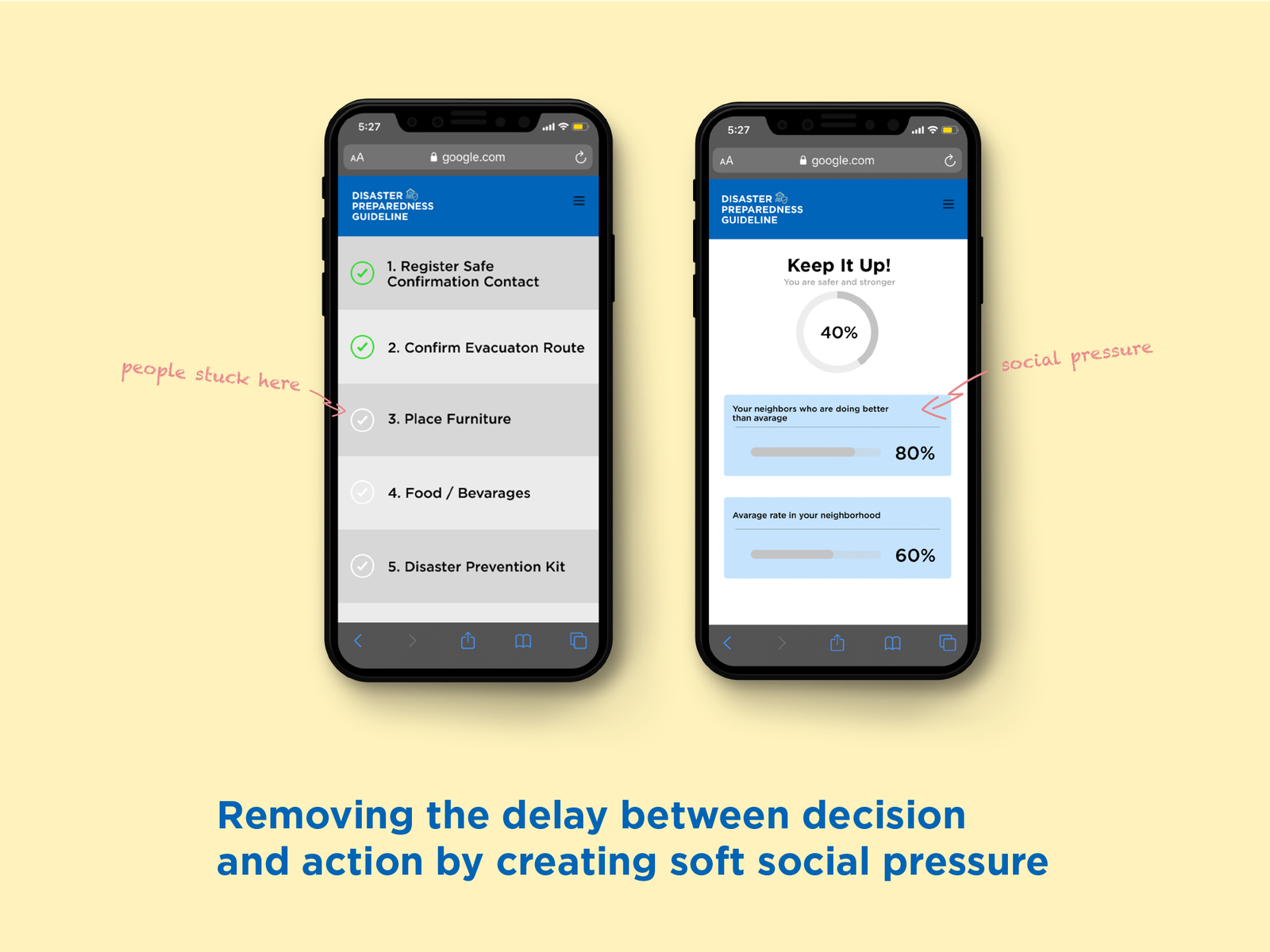
The first intervention was an email from the utility company along with the bill, in which they highlighted how much risk there was in the event of a natural disaster. Also, when it comes to heavy tasks like moving furniture, people are very demotivated, so I wanted to eliminate the delay between decision and action by putting soft social pressure on them.
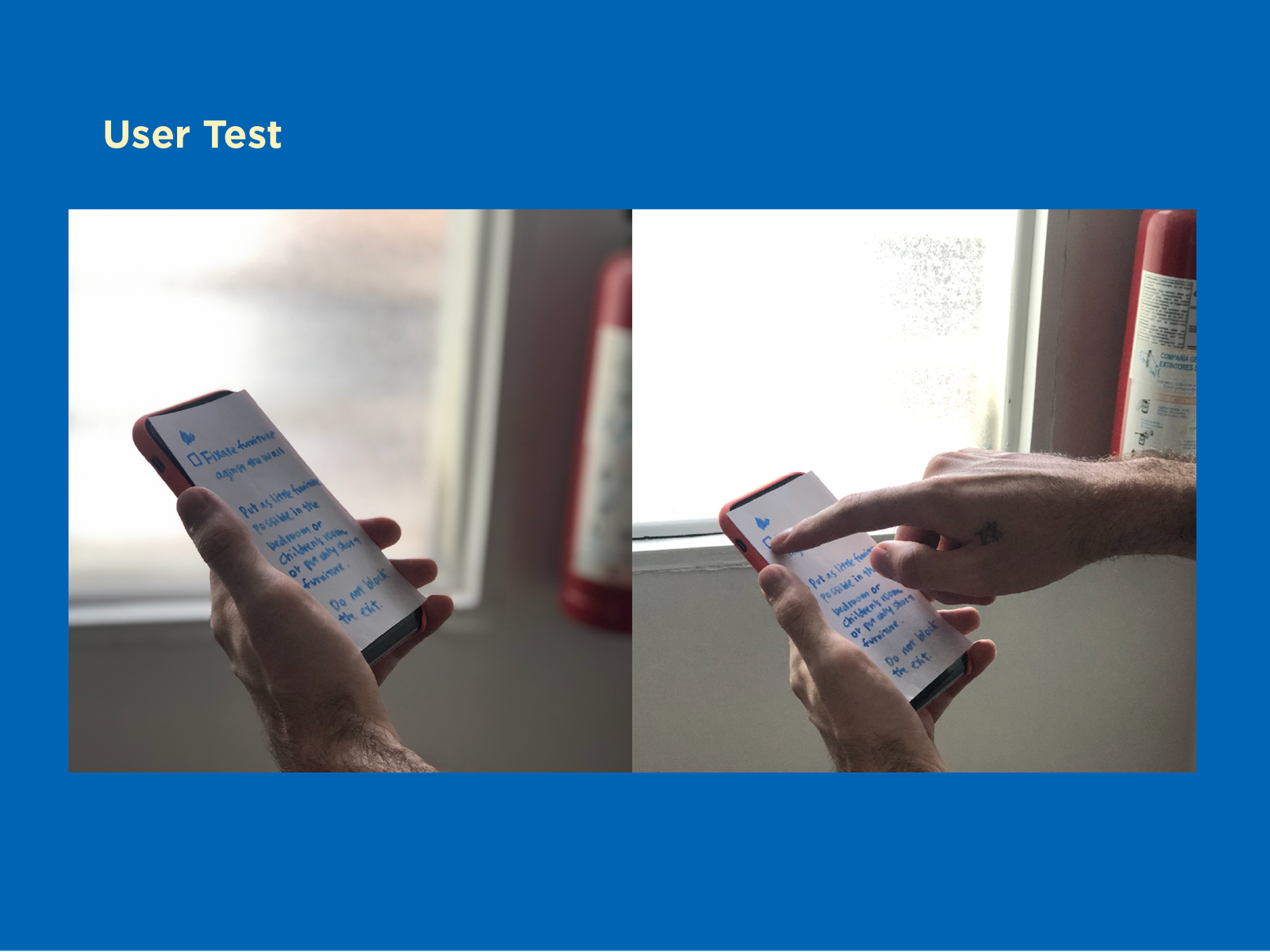
For the user testing, I wanted to learn when the earliest time in the process that decision-making and action collide so that I could prioritize those moments to nudge. Through this, I learned that downloading is not easy at first, and it is better to keep users on the same platform. Also, removing the delay is very important because the user knows it may take days to complete. After the user test, I changed the order of the tasks as an easy task comes first.
Through this concept, I wanted people to complete this list to feel mentally and physically well prepared for an unpredictable, large-scale natural disaster.